In this section we discuss constructibility by ruler and compass of regular
polygons.
Gauss' proved that a regular polygon of sides is constructible by ruler
and compass if and only if
where
and
are distinct Fermat primes.
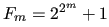
The number
is called a Fermat prime whenever it is
a prime. The known Fermat primes are:
and
Fermat showed that is a prime for . Eisenstein conjectured
that there are infinitely many Fermat primes. This conjecture is still
open. Euler showed that is
divisible by .
Proposition 5.1
(1837, Wantzel) Let a regular polygon of sides be constructible
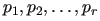
and be an odd prime dividing . Then is a Fermat prime.
Proof.
If and a regular -gon is constructible then a regular -gon is also
constructible. Thus the point
is a constructible
point. Hence there exists a field
such that
and
. Then
and hence
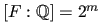
and therefore It follows that is a
power of Hence is a Fermat prime.
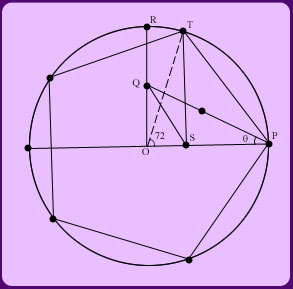
Figure : Richmond's construction of a regular pentagon







 be an odd prime dividing