Lecture 23
Solutions of Cubic and Quartic Equations
 

Quartic polynomials

We present Lagrange's method for the roots of quartic polynomials. We continue with the assumption that $ F$ has characteristics different from $ 2,3.$ Consider a general quartic polynomial $ f(x)=x^4+ax^3+bx^2+cx+d.$ We put $ y=x-a/4$ to get the polynomial $ g(y)=y^4+py^2+qy+r.$ Let $ r_1,r_2,r_3,r_4$ be roots of $ g(y).$ Consider the quantities

$\displaystyle \theta_1= (r_1+r_2)(r_3+r_4),\;
\theta_2= (r_1+r_3)(r_2+r_4),\;
\theta_3= (r_1+r_4)(r_2+r_3).
$

The cubic polynomial whose roots are $ \theta_1, \theta_2$ and $ \theta_3$ is called the resolvent cubic of the quartic polynomial. It turns out to be the polynomial

$\displaystyle h(x)=x^3-2px^2+(p^2-4r)x+q^2.$
Using the relation $ r_1+r_2+r_3+r_4=0$ we get
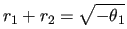
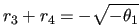
$\displaystyle r_1+r_2=\sqrt{-\theta_1}$ , $\displaystyle r_3+r_4=-\sqrt{-\theta_1}$
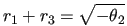
$\displaystyle r_1+r_3=\sqrt{-\theta_2}$ , $\displaystyle r_2+r_4=-\sqrt{-\theta_2}$
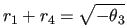
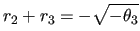
$\displaystyle r_1+r_4=\sqrt{-\theta_3}$ , $\displaystyle r_2+r_3 = -\sqrt{-\theta_3}$

One can show that $ \sqrt{-\theta_1}\sqrt{-\theta_2}\sqrt{-\theta_3}=-q.$ Hence two of the square roots determine the third. Adding the three equations on the left and using the fact that $ r_1+r_2+r_3+r_4=0,$ we get

$\displaystyle 2r_1=\sqrt{-\theta_1}+\sqrt{-\theta_2}+\sqrt{-\theta_3}.$
$\displaystyle 2r_2=\sqrt{-\theta_1}-\sqrt{-\theta_2}-\sqrt{-\theta_3}.$
$\displaystyle 2r_3=-\sqrt{-\theta_1}+\sqrt{-\theta_2}-\sqrt{-\theta_3}.$
$\displaystyle 2r_4=-\sqrt{-\theta_1}-\sqrt{-\theta_2}+\sqrt{-\theta_3}.$
This shows that the roots of the resolvent cubic determine the roots of the quartic.