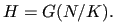
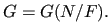
Let and be finite Galois extensions so that
Then the homomorphism
is injective. If
then is an isomorphism.
Proof.
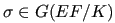
It is clear that is a group homomorphism. The kernel
of consists of
so that
for all and for all Hence such
Thus is injective.
Suppose that
Then by Corollary (21.3),
This shows that is an isomorphism.
The Normal Closure of an Algebraic Extension
Let be an algebraic extension and
The normal closure of in
is the splitting
field over of the polynomials
irr It is clear that is a normal extension of containing Moreover any normal extension
of containing must contain the splitting fields of
irr Hence If
then is the splitting
field of the polynomials
irr for all
If is separable then is a
separable extension as it is obtained by adjoining roots
of separable polynomials over Hence the normal closure
of when is separable, is a Galois extension.
Let be a separable extension that is not normal. Let be a normal closure of Put Then Let be a normal subgroup of Then
and is a normal extension
of Thus by minimality of Hence










 irr




 irr