Lecture 20
Cyclic Extensions and Solvable Groups
 

Since $ (G_i/C)/(G_{i+1}/C) \simeq G_i/G_{i+1}$ for all $ i,$ we have an abelian series:
$\displaystyle G \supset G_1 \supset G_2 \supset \cdots \supset G_s \supset C \supset 1.$
Thus $ G$ is solvable.


Definition 20.4
 

Let $ G$ be a group. The commutator $ [g,h]$ of $ g,h\in G$ is defined as $ [g,h]=g^{-1}h^{-1}gh.$ The derived subgroup of $ G$ denoted by $ G'$ is the subgroup generated by all the commutators in $ G.$ The $ k^{th}$ derived subgroup of $ G$ is defined inductively as $ G^{(k)}=(G^{(k-1)})'.$


Proposition 20.5
 

Let $ f: G \rightarrow H$ be a homomorphism of groups.
  1. $ f(G') \subseteq H'.$ If $ f$ is onto then $ f(G')=H'.$
  2. If $ K \lhd G$ then $ K' \lhd G.$ In particular $ G' \lhd G.$
  3. If $ K \lhd G$ then $ G/K$ is abelian if and only if $ G' \subseteq K.$
Proof.
  1. Let $ g,h \in G.$ Then $ f([g,h])=f(g)^{-1}f(h)^{-1}f(g)f(h)=[f(g),f(h)].$ Hence $ f(G') \subseteq H'.$ It is clear that equality holds true if $ f$ is onto.
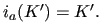
  2. Let $ a \in G.$ The inner automorphism $ i_a: G \rightarrow G$ restricts to an automorphism of $ K$ as $ K \lhd G.$ Hence $ i_a(K')=K'.$ Therefore $ K' \lhd G.$ Since $ G \lhd G,$ we have $ G' \lhd G.$
  3. Let $ K \lhd G.$ Then $ G/K$ is abelian $ \Leftrightarrow$ for all $ g,h \in
G,\;$ $ ghK=hgK \Leftrightarrow h^{-1}g^{-1}hg \in K$ for all $ g,h\in G$ $ \Leftrightarrow
G' \subseteq K.$

Proposition 20.6
 

A group $ G$ is solvable if and only if $ G^{(s)}=1$ for some $ s \in \mathbb{N}.$

Proof
.

Let $ G$ be solvable. Then there is an abelian series for $ G$
$\displaystyle 1 \lhd G_1 \lhd G_2 \lhd \cdots \lhd G_s=G.$

We show by induction on $ s$ that $ G^{(s)}=1.$ If $ s=1,$ then $ G$ is abelian. Hence $ [g,h]=1$ for all $ g,h \in G.$ Hence $ G'=1.$ Now let $ s >1.$ Then

$\displaystyle 1 \lhd G_1 \lhd G_2 \lhd \cdots \lhd G_{s-1}$
is an abelian series for $ G_{s-1}.$ Hence $ G_{s-1}^{(s-1)}=1.$ Since $ G/G_{s-1}$ is abelian, $ G' \subseteq G_{s-1}.$ Hence
$\displaystyle G^{(s)}=(G')^{(s-1)} \subseteq G_{s-1}^{(s-1)}=1.$
Conversely suppose that $ G^{(s)}=1$ for some $ s.$ Then
$\displaystyle G \rhd G^{(1)} \rhd G^{(2)} \rhd \cdots \rhd G^{(s)}=1$
is an abelian series for $ G.$ Thus $ G$ is solvable.