A splitting field of over is called a cyclotomic field of
order over .
Proposition 16.2
Let
char and
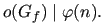
Then is isomorphic to a subgroup of In particular is an abelian
group and
Proof.
As is separable, it has distinct roots.
Let
be the set of roots of in and
Since
is a subgroup, it is cyclic. The map
such that
is an injective group homomorphism. Since
is an abelian group, is
also an abelian group whose order divides
.
Example 16.3
Let
Then
Any root of is a primitive cube root of unity over Hence
To find the degree of a primitive seventh root of unity
over consider the factorization of into irreducible polynomials
over
Therefore there are primitive roots of unity over with
two minimal polynomials. In contrast to this, we shall see that all the
primitive roots of unity over
have the same irreducible
polynomial called the cyclotomic polynomial


 char
char
![$ f(x)=x^{n} - 1 \in F[x].$](../../images/algebra4/img2367.png)















![$ [F(z):F]=2.$](../../images/algebra4/img2381.png)





