Lecture 12
The Primitive Element Theorem
 

Theorem 11.3 (The Primitive Element Theorem)
 

Let $ E/k$ be a finite extension.
  1. There is a primitive element for$ E/k$ if and only if the number of intermediate subfields$ F$ such that $ k \subset F \subset E$ is finite.
  2. If$ E/k$ is a finite and separable extension then it has a primitive element.

Proof
.
  1. If $ k$ is a finite field then $ E$ is finite and hence $ E^{\times}$ is a cyclic group. Thus $ E/k$ has a primitive element.

    Let $ k$ be infinite and let $ E/k$ have finitely many intermediate fields. Suppose $ \alpha,
\beta \in E$. As $ c$ varies in$ k$, $ k(\alpha + c \beta)$ varies over finitely many intermediate subfields of $ E/k$ Hence, there are $ c_{1} \neq c_{2} \in
k$ such that $ k(\alpha + c_{1}\beta) = k(\alpha + c_{2} \beta) := L$. Thus $ (c_{1} - c_{2}) \beta \in L. $ Therefore $ \beta \in L .$ Hence $ \alpha \in
L$. Thus $ k(\alpha, \beta) = k(\alpha + c _1\beta)$. Proceed inductively to show that $ E = k(\alpha_{1},
\ldots, \alpha_{n}) = k(\alpha_{1} + c_{2} \alpha_{2} + \cdots + \alpha_{n}
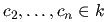
c_{n})$ for some $ c_{2}, \ldots, c_{n} \in k$.
    Conversely, let $ E = k(\alpha)$ for some $ \alpha \in E$ and $ f(x) =$   irr$ (\alpha,k)$. Let $ k \subset F \subset E$ be a tower of fields. Set $ h_{F} =$   irr$ (\alpha,F)$. Then $ h_{F} \mid f(x)$ as $ F$ varies over all the intermediate subfields of $ E/k$.

    Since $ h_{F}$ is irreducible over $ F$, it is also irreducible over $ F_{0}$, a subfield of $ F$ generated by the coefficients of $ h_F(x)$ over$ k$. Since $ \deg h_F(x)=[E : F]= [E : F_{0}], $ it follows that $ F = F_{0}$. Since there are finitely many divisors of $ f(x)$, there can be only finitely many intermediate fields of $ E/k.$

  2. Now let $ E/k$ be a finite separable extension. Then $ E = k(\alpha_{1},
\alpha_{2}, \ldots, \alpha_{n})$. To show that$ E/k$ has a primitive element it is enough to find a primitive element when $ n = 2$ and then apply induction on $ n.$ So let $ E = k(\alpha,
\beta)$. We look for a primitive element of the form $ \alpha + c \beta$ where $ c \in k$. Let $ [E : k] = n$. If $ \alpha + c \beta$ generates$ E/k$, then $ \alpha + c \beta$ must have $ n$ conjugates (images of $ \alpha + c \beta$ under the action of$ n$ embeddings of$ E$ into $ k^a$). Hence there exist$ n$ $ k$-embeddings $ \sigma_{1}, \sigma_{2}, \ldots,
\sigma_{n}: E \rightarrow \bar{k}$. which map $ \alpha + c \beta$ to $ n$ distinct roots of $ p(x) =$ irr $ (\alpha+c\beta),k)$ in $ \bar{k}$. Thus $ \alpha + c \beta$ is a primitive element if and only if there exist $ n$ embeddings $ \sigma_{1}, \ldots \sigma_{n} : E \rightarrow \bar{k}$ such that $ \sigma_{i} (\alpha + c \beta) \neq \sigma_{j} (\alpha + c \beta),
\;$for all$ \; i \neq j$, if and only if

% latex2html id marker 16936
$\displaystyle \prod_{i < j} (\sigma_{i}
(\alpha) -
\sigma_{j}(\alpha)) + c(\sigma_{i}(\beta) - \sigma_{j}(\beta)) \neq 0$

if and only if $ c$ is not a root of the polynomial

% latex2html id marker 16940
$\displaystyle f(x) = \prod_{i < j}
(\sigma_{i}(\alpha) - \sigma_{j}(\alpha)) + x(\sigma_{i}(\beta) -
\sigma_{j}(\beta)).$
Since $ k$ is infinite and $ f(x)$ has finitely many roots, such a$ c$ exists.