The above problems remained open for almost 2200 years. The final solution
employed techniques from abstract algebra and analysis. We will show that it is
impossible to construct side of a cube whose volume is 2 by ruler and compass.
The word Delian is derived from Delos which was a city in ancient Greece.
It is said that almost a quarter of population of Delos died of plague in 428
B.C. A delegation was sent to the oracle of Apollo at Delos to enquire how the
plague could be arrested. The oracle replied that the cubical altar to the Sun
God Apollo should be doubled. Instead of doubling the volume the faithfuls
doubled the sides of the cube thereby increasing the volume eightfold. The second
and the third problems also circulated among Greek geometers around the same
time. It is not known who solved the Delian problem first. The angle trisection
problem was solved by Gauss as a special case of his remarkable solution of the
fourth problem. Gauss, barely 19, provided a construction of the 17-sided
regular polygon. He also characterized  for which regular
  gons are
constructible by ruler and compass. Recall that a prime of the form
gons are
constructible by ruler and compass. Recall that a prime of the form
 is called a Fermat prime. Gauss proved that a regular gon is
constructible if and only if
is called a Fermat prime. Gauss proved that a regular gon is
constructible if and only if
 where
where  and
and
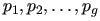 are distinct Fermat primes. Gauss's Theorem
solves the angle trisection problem. If
are distinct Fermat primes. Gauss's Theorem
solves the angle trisection problem. If  was constructible, then we can
construct a regular
was constructible, then we can
construct a regular  -gon. Since
 , we have a contradiction.
The values of for which regular gons were known to be constructible up to
the time of Gauss were
 and
and  . No one was
able to construct a heptagon or a regular
. No one was
able to construct a heptagon or a regular  gon.
gon.
In March, 1796 Gauss made his first mathematical discovery : construction of a
17-sided regular polygon by ruler and compass. He began noting down his
mathematical discoveries in a diary which he maintained for the next 19 years.
Gauss published
 in
1801 which has become a classic in mathematical literature. The last result of
this is his solution to the fourth problem.
Gauss was very proud of this discovery. He desired that a regular polygon of
in
1801 which has become a classic in mathematical literature. The last result of
this is his solution to the fourth problem.
Gauss was very proud of this discovery. He desired that a regular polygon of  sides be engraved on his tombstone. This wish was not fulfilled. It was
fulfilled when a monument to Gauss was built in his birth place Braunschwig.
Explicit construction of sided regular polygon was given by Erchinger in
1800. In 1892 Richelot and Schwendenwein constructed a regular
sides be engraved on his tombstone. This wish was not fulfilled. It was
fulfilled when a monument to Gauss was built in his birth place Braunschwig.
Explicit construction of sided regular polygon was given by Erchinger in
1800. In 1892 Richelot and Schwendenwein constructed a regular  gon. Around
1900 Hermes constructed a regular 65537-gon. The manuscript fills a box and it
is found in Góttingen. The construction has now been computerized. See an
article by Bishop in American Math. Monthly (1978).
gon. Around
1900 Hermes constructed a regular 65537-gon. The manuscript fills a box and it
is found in Góttingen. The construction has now been computerized. See an
article by Bishop in American Math. Monthly (1978).
Lindemann proved in 1882 that  is not a root of any polynomial with
rational coefficients. This proved the impossibility of squaring a circle.
is not a root of any polynomial with
rational coefficients. This proved the impossibility of squaring a circle.
