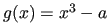
Let  be the Galois group of an irreducible quintic over
 Show that
  or
or  if has an element of order
Solution: Let  be an irreducible quintic over
Then its Galois
group is a transitive subgroup of
be an irreducible quintic over
Then its Galois
group is a transitive subgroup of  Hence we see that the order of is a
multiple
of
Hence we see that the order of is a
multiple
of  Thus
Thus
 or
or  We must show that it cannot have
order
We must show that it cannot have
order  or
or  If the order is then it is cyclic. But there is no
permutation
of oder in Suppose
If the order is then it is cyclic. But there is no
permutation
of oder in Suppose  Then due to simplicity of
  is not a subgroup of
  Hence has an odd permutation say
  Then
Then  is either a product of
two disjoint
cycles of order
is either a product of
two disjoint
cycles of order  and
and  or a
or a  -cycle. In the latter case
 which is
not possible. In the former case
which is
not possible. In the former case  is a transposition. But such a group
is
is a transposition. But such a group
is











![$ F(d):F]=2.$](../../images/algebra4/img3425.png)