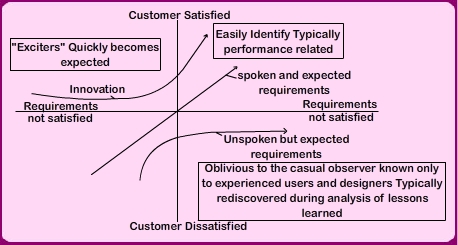
Kano model, which is shown in Figure 2-23, conceptualizes customer requirements. The model represents three major areas of customer satisfaction. The first area of customer satisfaction, represented by diagonal line, represents explicit requirements. These include written or verbal requirements and are easily identified, expected to be met, and typically performance related. Satisfying customer would be relatively simple if these were the only requirements.
The second area of customer satisfaction represents innovations, as shown by curved line in the upper left corner of the figure. A customer's written instructions are often purposefully vague to avoid stifling new ideas during conceptualization and product definition. Because they are unexpected, these creative ideas often excite and delight the customer. These ideas quickly become expected w.r.t time.
The third and most significant area of customer satisfaction represents unstated or unspoken requirements, as shown by the curve in the lower right corner of the Figure. |