Example 1.1:
Let us consider the circuit shown in Fig. 1.19 (a) which contains the equivalent circuit of a transformer. Let the transformer rating be
500 MVA, 220/22 kV with a leakage reactance of 10%.
The VA base of the transformer is 500 MVA and the voltage bases in the primary and secondary side are 200 kV and 22 kV respectively. Therefore the impedance bases of these two sides are
 Ω and Ω and  W W
where the subscripts 1 and 2 refer to the primary (high tension) and secondary (low tension) sides respectively. Assume that the leakage reactance is referred to the primary side. Then for 10%, i.e., 0.1 per unit leakage reactance we have
 Ω Ω
The above reactance when referred to the secondary side is
 Ω Ω
Hence the per unit impedance in the secondary side is 0.0968/0.968 = 0.1. Therefore we see that the per unit leakage reactance is the same for both sides of the transformer and, as a consequence, the transformer can be represented by only its leakage reactance. The equivalent circuit of the transformer is then as shown in Fig. 1.22. Since this diagram only shows the reactance (or impedance) of the circuit, this is called the reactance (or impedance ) diagram .
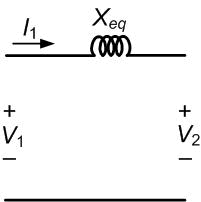
Fig. 1.22 Per unit equivalent circuit of a transformer.
|

