Module 5 : Real and Reactive Power Scheduling
Lecture 24 : Real and Reactive Power Scheduling
Optimal Power Flow - An example

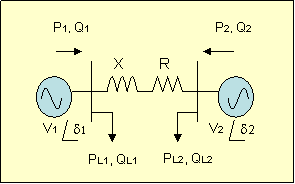
Consider a 2 generator system which supplies 2 loads at buses 1 and 2. Compute the minimum cost real and reactive power schedule of the generators if the cost of real power (power is in per-unit) is:

C1 = 50 *P1 + 300 * P1²

C2 = 50 *P2 + 250 * P2²

Reactive power is assumed to be free. The following limits are applicable: Voltages at both buses should be between 0.975 pu and 1.025 pu. Generated real power for each generator should be less than 3 pu. Reactive power capability is assumed to be unlimited.

R+j X = 0.02 +j 0.1, PL1 + j QL1 = 4.0 + j*2.0, PL2+ jQL2 = 1.5 +j*0.75 pu


The problem can be stated formally as follows:

Total cost is given by : C = C1+C2 which is to be minimized.

subject to

P1 - PL1 - V1²*cosf / Z - V1*V2*cos(f + d1-d2) /Z = 0

P2 - PL2 - V2²*cos f /Z - V1*V2 *cos(f + d2-d1) /Z = 0

and

V1 - 1.025 < 0, V2 - 1.025 < 0,

0.975 - V1 <0, 0.975 - V2 <0 ,

P1 < 3.0, P2 < 3.0

where Z =| R+jX |, and f = arctan(X/R)

Note that there are implicit equality constraints which are present due to real and reactive power balance equations at the 2 nodes. The auxiliary variables are V1, V2 and d1-d2. Note that d1 and d2 cannot be obtained as independently and uniquely since they appear as (d1-d2) in all equations (i.e., if d1 and d2 satisfy the equations, then d1+g and d2+g also satisfy them, g being an arbitrary choice).