|
Module 9
Lecture-1
Attributes of the visual elements for an understanding of the visual principles of composition balance, rhythm, contrast, harmony, order and chaos.
Some basic design elements are outlined below to understand the visual principles.
Balance:
Balance implies that the visual elements within the frame have a sense of weight. Large objects generally weigh more than small objects and dark objects weigh more than light coloured objects. The position of the visual elements is also critical. We unconsciously assume the center of a picture corresponds to a fulcrum. A heavy weight on one side can be balanced by a lighter weight on the other side if the lighter weight is located at a greater distance from the fulcrum.
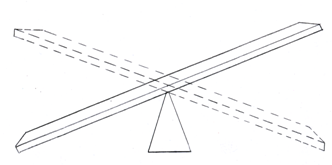
Fig. 124. Balance of visual elements .
Visual interest is what we balance in design. Different colours, shapes sizes, etc. create different degrees of interest. It is the distribution of this interest that you need to control. Subject matter changes the situation because different objects can call more (or less) attention to themselves because
of their content and relationships to other objects in the image.
Balance can also be described as achieving equilibrium. But artist generally refuse to accept this term in their world. It usually means that no part of the composition calls too much attention to itself at the expense of the rest of the image. This increases unity, but decreases variety, and hence interest.
|
