Line:
As the point travels from one location to another in space, it becomes the line. The line has length but no breadth or height as it the path of the point from one location to another. It only has a position and direction.

Fig.112: A line as a point that ‘travels'
Line is a basic component for making a layout of art that appears in most two-dimensional artworks. Line can be used in many different ways within art. How do lines aid an artist in constructing a visually-effective composition. Followings are some of the examples.
Curvilinear Lines:
Lines within a work of art can either be curvilinear or rectilinear. Curvilinear lines are often referred to as organic lines and they are curvy and free-flowing. Curvilinear can create a soft natural feel within a work of art. Curvilinear lines are commonly seen in artwork depicting the female form. A dominant use of curvilinear lines is also often evident in art nauvough works that project a sense of warmth and a connection to the natural world.Fig.107 shows
The use of curvilinear lines in artwork.
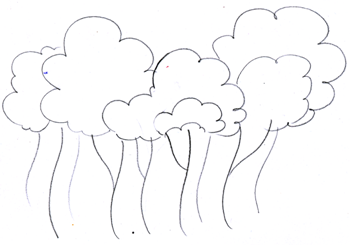
(a) Mix of curvilinear lines in various shapes.
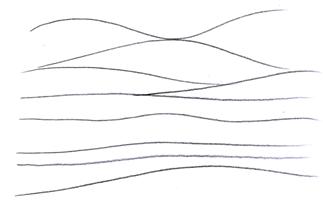
(b) Simple straight curvilinear lines.
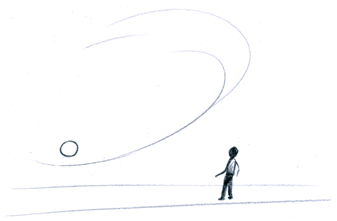
(c) hemi-spherical curvilinear lines conveying subject and motion.
Fig.113: Conveying motion through lines
|

