Regardless of the position or angle of an ellipse, its major and minor axes always appear at right angles, to each other. When drawing a cylinder its centre line must always be drawn as an extension of related ellipse's minor axis. Therefore this centre line always appears at right angle to the major axis of the ellipse associated with it, but this centre line connects to the ellipse at the centre point of the circle and not to the centre point of the ellipse.
Cones:
Drawing cones is similar to the drawing of cylinders; the centre line of a cone is also the extension of the axis of the ellipse related with the cone. It usually lies at right angle to the ellipse's major axis, and it connects to the ellipse not at the ellipse's centre point, but behind it.
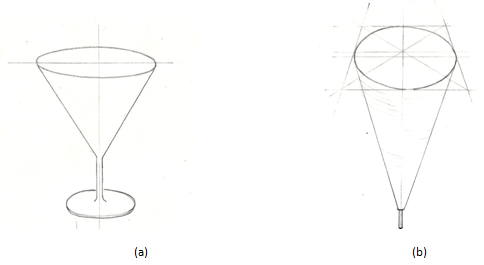
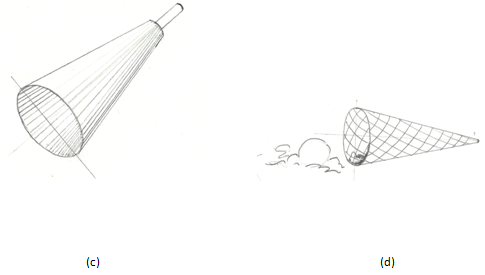
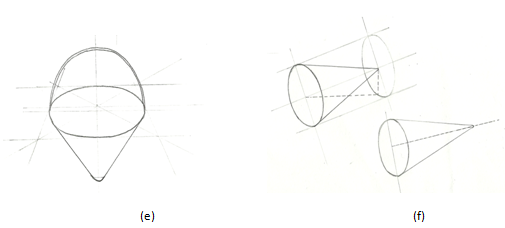
Fig.103: Drawing of a cone.
The cone within the cylinder naturally has its centre line parallel to the table top, therefore the cone's apex is in the air, to draw the cone resting on the table its apex must drop to a level at the table top so that its centre line also falls approximately to the dotted line. Therefore cones lying on any plane have their centre line inclined to the plane on which they are lying.
|

