|
Lecture-2
Structure of forms:
Any form is basically built of points, lines, planes and volume and either they are positive or negative. Visible points, lines and planes are forms in the true sense; although forms as points or lines are still simply called points or lines in common practice.
Point as a form:
A form may be recognized as a point if it is small. The smallness here is completely relative as any form may appear huge as compared to any tiny frame may appear huge or they depending on the frame of reference but the same form may appear large when it is put into a much greater frame of reference. As an example shown below a point can be a football if we go closer to the point or in other words, if we zoom it, the point may appear as a football visually (Fig.3). The most common shape is that of a circle which has features like non-directional, non-angular, compact and simple. However, a point may also be a square, triangle, oval or even an irregular shape (Fig.4). Thus, the features of a point are: it should be comparatively small and its shape should be simple.
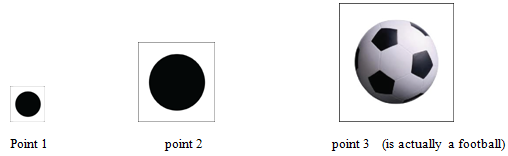
Fig. 3: Point as a football

Fig.4: Various types of points depending on purpose.
Though mathmetically, a point dose not have dimensions, visually speaking,a point may have regular or irregular shapes.
Line as form:
Any form is said to be a line because of two reasons: first its breadth is extremely narrow and second its length is quiet visible and prominent. It generally portrays the feeling of thinness; however, this thinness is also relative to the comparison or frame of reference. Usually the ratio between the length and the breadth (of its extreme) is considered. As an example given in Fig.5 a line can be a wooden log when we go closer to the line and see. Line is a form of a wooden log. Fig.5
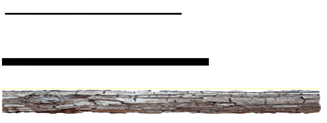
Fig. 5: A wooden log seen from a distance appears as a line.
|
