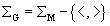
. Then L-{
 } is a context-sensitive language.
Proof : We need to construct an equivalent CSG G that simulates the computation of the LBA M. Note that the techniques used to construct an equivalent unrestricted grammar that simulates the computations of a TM (as given in theorem ....) cannot be adopted directly. The reason is that if the CGS simulated the LBA using distinct symbols for the states and the endmarkers , then it could never erase these symbols later to produce the original input string since it would violate the noncontracting or monotonicity property of a CSG. Because use of a production in a derivation to erase a symbol in a sentential form would produce a starter sentential form. Hence the endmarkers must be incorporated into adjustment tape symbols and similarly the states must be incorporated into the symbols scanned by the tape head. The input alphabet of G is obtained from  by removing the endmarkers. Nonterminals of G are ordered pairs-the first component is a terminal symbol and the second component is a string consisting of a combination of a tape symbol and (possibly) a state and endmarkers. The construction of the CSG G =
  is as follows.