- Main idea in this method is to compare two adjacent elements and put them in proper order if they are not.
- Do this by scanning the element from first to last.
- After first scan, largest element is placed at last position. This is like a largest object sinking to bottom first.
- After second, scan second largest is placed at second last position.
- After n passes all elements are placed in their correct positions, hence sorted.
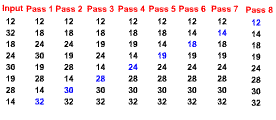
- The algorithmic description of the Sink sort is given below:
Algorithm Sink-Sort (a[n])
for i = 0 to n-2 do
swap(a[j],a[j+1]);
- The algorithm can be modified, such that, after each pass next smallest element reach to the top position.This is like a bubble coming to top. Hence called Bubble-Sort.