As mentioned earlier, the cost as well as the benefit is spread over the time horizon. It is difficult to compare the cost/ benefit components, unless they are brought to equivalent values at a particular base year.
There are various methods available for economic evaluation of highway projects, which enables an analyst to compare relative benefits which could be derived from various alternative projects.
The various methods of economic evaluation of highway projects are discussed briefly in the following.
Cost-Benefit Ratio Method
In cost benefit ratio analysis, the costs and the benefits of individual highway projects are calculated, bringing all the expenditures to the base year for comparison purposes. The cost-benefit ratios of the various alternative highway projects are then compared.
Net Present Value Method
In the net present value method, the cost and the benefits of the individual years are discounted to the present value and compared across various alternatives. The Net Present Value ( NPV ) at the base year can be written as:
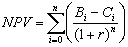 .(5) .(5)
where, B i is the benefit of the i th year, C i is the cost of the i th year and n is the number of years.
Internal Rate of Return Method (IRR)
Internal rate of return is that discount rate, for which the NPV value is zero. This can be obtained by setting the value of NPV in Equation (5) as zero, and solving (by trial and error) for the value of r . If the rate of return thus calculated is more than the market interest, then the project is adjudged to be acceptable.
Comparison of various methods
• The cost-benefit model is simple to use, but sometimes when the cost-benefit ratio of two models are close to each other, it becomes difficult to interpret, and choose the best option.
• Some components whether will be treated as benefit or cost (i.e. whether it will go to the numerator or denominator), sometimes appear confusing. This is because savings in cost is benefit in other words.
• In the NPV or cost-benefit ratio methods, some discount rate is assumed, and various alternative projects are compared. If different discount rate is assumed instead, the order of choice among the alternatives may change.
• IRR method itself finds out the discount rate, and therefore inaccuracy in analysis in assuming some arbitrary discount rate (as is done in cost-benefit ratio or in NPV method) is taken care.
Thus, IRR method seems to be the most preferred economic analysis tool.
|
