| VISCOUS FLOW | ||||
In order to determine the Reynolds stresses in turbulent flows Thus, turbulent shear stress becomes,
|
||||
Turbulent Velocity Profile |
||||
| A fully developed turbulent flow in a pipe can be divided into three regions which are characterized by their distances from the wall: the viscous sub-layer very near to the pipe wall, the overlap region and the outer turbulent layer throughout the center portion of the flow. Within the viscous sub-layer the viscous shear stress is dominant compared to that of turbulent (or Reynolds) stress i.e. fluid viscosity plays a major role compared to fluid density. In the outer turbulent layer, Reynolds stresses (i.e. fluid density) are dominant and there is a considerable mixing and randomness to the flow. |
||||
| Prev | ||||
 , several empirical theories have been attempted. The most common one is Prandtl's concept of "mixing length". He proposed that the turbulent process could be viewed as the random transport of bundles of fluid particles over a certain distance
  from a region of one velocity to another region of different velocity. This distance is called "mixing length". In this mixing length, the eddy viscosity may be defined as,
 (9)
(9)
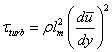 (10)
(10)