| VISCOUS FLOW | |||||
Turbulent Stresses |
|||||
In order to define stresses in turbulent flows, let us write the x- momentum equation with time averaging and fluctuation terms; i.e.
where
|
|||||
| Prev | |||||
| VISCOUS FLOW | |||||
Turbulent Stresses |
|||||
In order to define stresses in turbulent flows, let us write the x- momentum equation with time averaging and fluctuation terms; i.e.
where
|
|||||
| Prev | |||||
 (5)
(5) are called "turbulent stresses" because they have same dimensions as that of laminar shear stress terms i.e.
 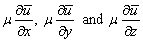 . The turbulent stresses are unknown and must be related to experimental flow conditions and geometry. However, experiments in pipe flows reveal that the stress associated with
  in y- direction is dominant. Hence, with reasonable accuracy, the momentum equation is reduced to,
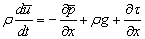 (6)
(6)  (7)
(7)