| DYMAMICS OF FLUID FLOW | ||||
FULLY DEVELOPED FLOW |
||||
The fluid typically enters to the pipe with nearly uniform velocity at some location. The region of the flow near which the fluid enters is known as "entrance region". Referring to Fig. 2 (a), the velocity profile at section (1) is nearly uniform. As the fluid moves through the pipe, the velocity at the wall approaches to zero due to viscous effect and is commonly called "no-slip boundary condition". Thus a boundary layer is produced along the pipe wall such that the initial velocity profile changes with distance along the pipe. At the end of entrance length i.e. beyond the section (2), the velocity profile does not vary with the distance. The boundary layer completely grows to fill the pipe where the viscous effects are predominant. For the fluid within the "inviscid core" and surrounding the centerline from (1) to (2), the viscous effects are negligible. The flow between the section (2) and (3), is "fully developed" until there is any change in the character of the pipe. The shape of the velocity profile depends on whether the flow is laminar or turbulent which in turn affects the length of the entrance region |
||||
| Prev | ||||
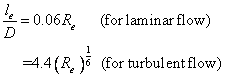
 . The dimensionless entrance lengths
 can be correlated with Reynolds number as,