Darcy's law
Darcy's law can be used for calculation of groundwater recharge rate. In case of unsaturated zone, the Darcy's law can be written as,
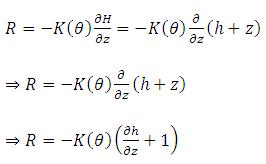
Where, K(θ) is the unsaturated hydraulic conductivity at the ambient water content, H is the total head, h is the matric pressure head and Z is the elevation head.
Tracer techniques
Chemical or isotopic tracers can also be used for estimation of groundwater recharge. In this method, the tracer is applied as a pulse at the soil surface or at some depth below the soil surface. After some time from the application of tracer, the vertical distribution of tracer under the ground is obtained. The vertical distribution of tracer is then used for estimation of the recharge rate.

where δz is depth of the tracer peak, δt is the time between tracer application and sampling, and θ is volumetric water content. Most commonly use tracer are, visible dyes, bromide and 3 H (Scanlon, et al 2002).
Advantages of groundwater recharge
- 1. Exploit the surplus surface water which otherwise drains off.
2. Enhance the reliability of yield from pumping wells.
3. Reduction of surface runoff which can eventually reduce the risk of urban flooding.
4. Reduce the risk of inundation of large surface areas and loss of crops.
5. Improvement of water quality due to the removal of harmful chemicals, suspended sediments, etc. in the filter layer.
6. Large storage structures are not required to store water.
7. No displacement of local people unlike the other water resources projects.
8. Reduction in cost of energy for lifting water as water table rises due to groundwater recharge.