- Explain the concept of 3Rs and waste management hierarchy?
- What is the aim of integrated solid waste management program?
- Bring out the difference between a natural attenuation landfill and an engineered landfill.
- Explain the important details required for deciding landfill site.
- Discuss in detail the multicriteria method for landfill site selection.
- What is the importance of waste characterization?
- What are the factors influencing leachate quality and quantity?
- How to estimate leachate and gas generation rate?
- With a neat figure, explain a conceptual liner and cover in landfill.
- What is the major role of soil in a waste containment facility?
- What are the requirements of compacted liner?
- Explain in steps the design philosophy of waste containment liner system.
- Starting from the basics, derive the differential equation for defining contaminant transport for reactive contaminant. Every phenomena governing differential equation need to be discussed in detail.
- With neat figures, explain laboratory method for establishing a) hydrodynamic dispersion coefficient, b) retardation coefficient, c) diffusion coefficient of unsaturated soil with low water content d) partition coefficient.
- What are the major differences between physisorption and chemisorption?
- Explain the batch method for establishing sorption characteristics of the soil-contaminant system.
- Explain the physical significance of sorption characteristics and its importance in contaminant transport modeling.
- What are the different isotherms used for establishing sorption characteristics?
- What are the different contaminant transport phenomena?
- What is diffusion and when it is expected to dominate contaminant transport phenomena?
- What is retardation coefficient and how it is helpful in determining ionic velocity?
- A column test was conducted to determine dispersion coefficient. The soil used was a silty clay with specific gravity 2.7. The diameter and height of the saturated soil column is 5 cm and 7cm, respectively with a water content of 35%. Calculate the pore volume of the soil column. An advective flux equal to 0.003 kg/day/m2 of 1000 mg/l SrCl2 has flown through the soil column for 5 hrs. Determine the total pore volume and number of pore volume for 5 hrs. The longitudinal hydrodynamic dispersion coefficient is 1.267 x 10⁻⁹ m2/s with a tortuosity coefficient of 0.7. The molecular diffusion coefficient of Sr+2 is 7.9 x 10⁻¹⁰ m2/s. Determine the longitudinal dispersivity for the soil-contaminant system.
- A batch test was conducted for 3 soil samples A, B, C with an initial concentration of 100 mg/l of SrCl2. 5 g of each of the soil sample is mixed with 50 ml, 100 ml, and 250 ml of SrCl2 and the values of Ce for A are 10, 8 and 6 mg/l, for B it is 12, 10 and 8 mg/l and for C it is 4, 3, 2 mg/l respectively. Compare the reactivity of the soil-contaminant system of the three soils and comment on the role of liquid to solid ratio on the sorption capacity of the three soil. Make any suitable assumptions.
- Specific discharge in the field is given as 1.68x10⁻⁸ m/s. Bulk density of fully saturated porous medium is 1.6 g/cc with volumetric water content of 0.4. Partition coefficient of lead obtained by linear isotherm is 10 ml/g. Determine average velocity of lead. What will be the velocity of lead if it is assumed as non-reactive with porous medium?
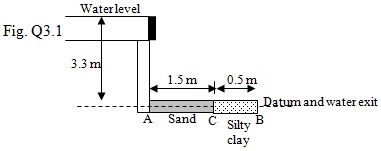
- A drainage pipe became blocked during a storm event by a plug of sand and silty clay as shown in figure Q3.1. When the storm ceased, water level above ground is 1 m. Permeability of sand is 2 times that of silty clay.
- Obtain variation of head components and total head for the length of drainage pipe
- b) Calculate pore water pressure at centre of sand and silty clay
- Find average hydraulic hydraulic gradient in both soil plugs.
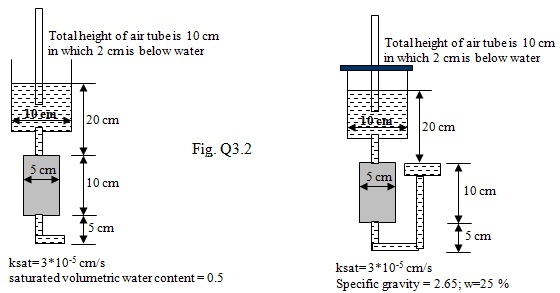
- Determine the quantity of flow and seepage velocity for constant head set ups given below (Fig. Q3.2) in SI units.