Hydrologic horizons
For defining water potential, interaction and movement in soil, it is always convenient to define three hydrologic horizons. These horizons vary in depth and thickness spatially and temporally. One or more of these horizons may be absent as well at a particular place. These three horizons are otherwise termed as zones. These zones are listed as follows and the same is depicted in Fig. 2.11. As depicted in the figure, the boundaries of these horizons have been shown to be horizontal for the sake of convenience. In the field these boundaries may be irregular.
a) Groundwater zone
This zone is otherwise termed as phreatic zone. This zone exists below ground water table and hence will be fully saturated. Mostly, the saturated soil mechanics is applicable for this zone. Depending upon the factors such as season, rainfall, proximity to water bodies etc. the depth of water table varies and hence the thickness of phreatic zone. All the voids in this zone are filled with water and water pressure will be always positive.
b) Vadoze zone
The partially saturated zone or unsaturated zone above water table is termed as vadoze zone. This zone extends from the top of the groundwater table to the ground surface. The voids are filled with air or water and the relative percentage is decided by the amount of saturation. The concepts developed for saturated soil mechanics is not applicable for unsaturated zone. Hence, the details of this zone are described in detail in the next section. Lowest portion of this zone can be nearly saturated due to the phenomenon of capillary rise. However, the water in this zone will be held under tension. The capillary height (hc) marked in the Fig. 2.11 is expressed as
 |
2.34 |
T is the surface tension of water, ρw is the density of water, g is the acceleration due to gravity, r is the soil pore radius, θ is the contact angle made by water-air interface where it contacts the soil solids.
c) Root zone
This zone corresponds to the top portion of vadoze zone close to ground surface where the plants and tress grows. Moisture dynamics is more in this zone due to the fact that roots draw water and nutrients from the soil. This zone is also subjected to evaporation and evapotranspiration and is in direct interaction with the atmosphere. During precipitation, infiltration and flow of water to the subsurface occurs through this zone.
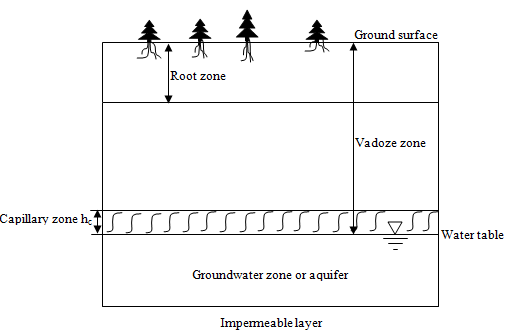 |
Fig. 2.11 Various hydrologic horizons |