Different Forms of Particle Size Distribution
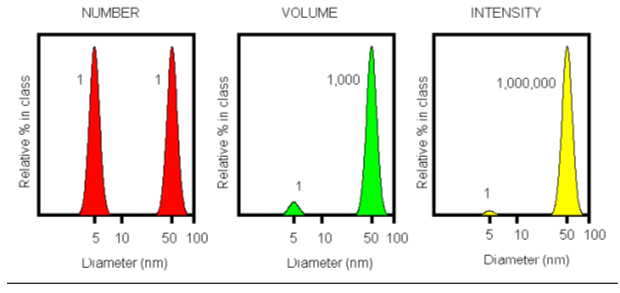
• Consider 2 populations of spherical particles of diameter 5nm and 50nm present in equal numbers.
• If a number distribution of these 2 particle populations is plotted, a plot consisting of 2 peaks (positioned at 5 and 50nm) of a 1 to 1 ratio would be obtained.
• If this number distribution was converted into volume, then the 2 peaks would change to a 1:1000 ratio (because the volume of a sphere is proportional to d3).
• If this was further converted into an intensity distribution, a 1:1000000 ratio between the 2 peaks would be obtained (because the intensity of scattering is proportional to d6 from Rayleigh's approximation).
• In DLS, the distribution obtained from a measurement is based on intensity.