How an Auto Correlator Works
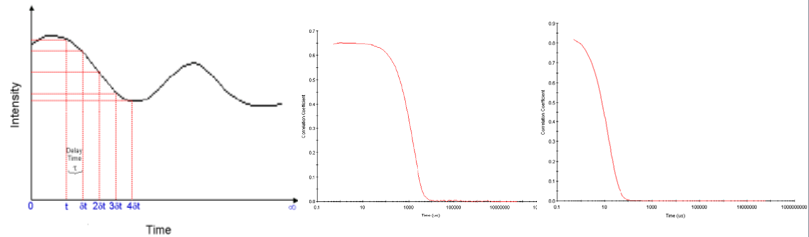 • If the intensity of a signal is compared with itself at a particular point in time and a time much later, then for a randomly fluctuating signal it is obvious that the intensities are not going to be related in any way, i.e. there will be no correlation between the two signals.
• However, if the intensity of signal at time t is compared to the intensity a very small time later (t+δt), there will be a strong relationship or correlation between the intensities of two signals.
• Perfect correlation is indicated by unity (1.00) and no correlation is indicated by zero (0.00).
• If the signals at t+2δt, t+3δt, t+4δt etc. are compared with the signal at t, the correlation of a signal arriving from a random source will decrease with time until at some time, effectively t = ∞, there will be no correlation.
• If the particles are large the signal will be changing slowly and the correlation will persist for a long time. If the particles are small and moving rapidly then correlation will reduce more quickly.