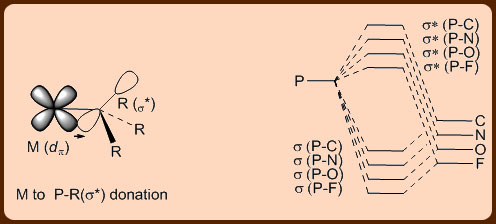
Phosphines are two electron donors that engage a lone pair for binding to metals. These are thus considered as good σ−donors and poor π−acceptors and they belong to the same class with the aryl, dialkylamino and alkoxo ligands. In fact they are more π−acidic than pure σ−donor ligands like NH3 and, more interestingly so, their π−acidity can be varied significantly by systematic incorporation of substituents on the P atom. For example, PF3 is more π−acidic than CO. Analogous to what is observed in case of the benchmark π−acidic CO ligand, in which the metal dπ orbital donates electron to a π* orbital of a C−O bond, in the case of the phosphines ligands, such π−back donation occurs from the metal dπ orbital occurs on to a σ* orbital of a P−R bond (Figure 2). In phosphine ligands, with the increase of the electronegativity of R both of the σ and the σ* orbitals of the P−R bond gets stabilized. Consequently, the contribution of the atomic orbital of the P atom to the σ*−orbital of the P−R bond increases, which eventually increases the size of the σ* orbital of the P−R bond. This in turn facilitates better overlap of the σ* orbital of the P−R bond with the metal dπ orbital during the metal to ligand π−back donation in these metal phosphine complexes. |