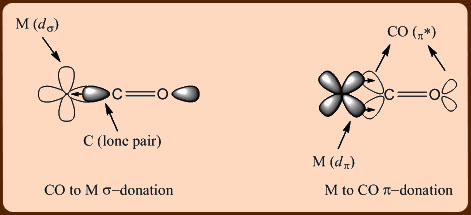
In the metal carbonyl complexes, the direct bearing of the π−back donation is observed on the M−C bond distance that becomes shorter as compared to that of a normal M−C single bond distance. For example, the CpMo(CO)3CH3 complex, exhibits two kind of M−C bond distances that comprise of a longer Mo−CH3 distance (2.38 Å) and a much shorter Mo−CO distance (1.99 Å) arising out of a metal to ligand π−back donation. It becomes thus apparent that the metal−CO interaction can be easily characterized using X−ray crystallography. The infrared spectroscopy can also be equally successfully employed in studying the metal−CO interaction. Since the metal to CO π−back bonding involves a π−donation from the metal dπ orbital to a π* orbital of a C−O bond, significant shift of the ν(CO) stretching frequency towards the lower energy is observed in metal carbonyl complexes with respect to that of free CO (2143 cm−1). |