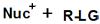
Solvent may play a vital role in the rate of SN2 reaction as it involves either creation or dispersion of charge (particularly in the transition state).
Charged species are more stabilized in polar solvent than non-polar solvent.
Difference between the solvation capacity of reactant and transition state in various solvent lead to the solvent effect in a reaction.
Reactants
Transition State
Charge Creation/Dispersion
Effect of Increasing the Polarity of Solvent
Charge dispersion
Retard the reaction
Charge dispersion
Retard the reaction
Charge dispersion
Retard the reaction
Charge dispersion
Retard the reaction
In the case of a negatively charged nucleophile, a remarkable change in the rate of SN2 reaction is observed while changing the solvent from polar protic to polar non-protic solvent.
In polar aprotic solvents, negatively charged nucleophile are generally less soluble but solvent are polar enough to solubilize the nucleophile making them highly reactive.
Solubility of nucleophile is a major problem in substitution reactions,particularly in less polar aprotic solvents.
Crown ether is added to solvate the counter-cation which induce the solubility of corresponding anionic nucleophile.