Network with four-fold symmetry (contd...)
Question is can we now extend these ideas for non-zero temperature. More relevant question is can we sample the configurations of any one plaquette in such a manner that it resembles the average configuration of the whole network.
The approach to do this is the following: We consider that the plaquettes assume shapes of parallelograms with one side fixed at zero temperature length  . Thus the parallelogram assumes different shapes as one vertex as it samples different co-ordinates in two dimensional space. In essence we are talking about a mean field model in which the behavior of plaquettes are identical to each other and also to that of the network. In reality the plaquettes are not independent, rather correlated locally, something which is missing in our approach. Furthermore, the following approach will not consider the more general quadrilateral shapes that would appear with rise in temperature, nor the length of the fixed side will remain constant. . Thus the parallelogram assumes different shapes as one vertex as it samples different co-ordinates in two dimensional space. In essence we are talking about a mean field model in which the behavior of plaquettes are identical to each other and also to that of the network. In reality the plaquettes are not independent, rather correlated locally, something which is missing in our approach. Furthermore, the following approach will not consider the more general quadrilateral shapes that would appear with rise in temperature, nor the length of the fixed side will remain constant.
In any case, our network consists of  plaquettes, vertices and plaquettes, vertices and  springs, so that each plaquette consists of 1 vertex, and 2 springs, one of length and the other one of length springs, so that each plaquette consists of 1 vertex, and 2 springs, one of length and the other one of length  . Then the potential energy of the plaquette is written as, . Then the potential energy of the plaquette is written as,
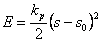 |
(39.7) |
Then the corresponding Boltzmann factor can be written as
 |
(39.8) |
Where, we have introduced two variables,  and and  . Then the probability of finding the chain at a length between and and orientation between angles θ and . Then the probability of finding the chain at a length between and and orientation between angles θ and  can be written as can be written as  . However, energy does not depend on θ, hence, the probability distribution is, . However, energy does not depend on θ, hence, the probability distribution is,
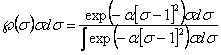 |
(39.9) |
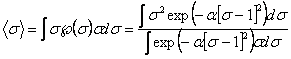
The ensemble average  of the plaquette can be estimated from the sides of the parallelogram as of the plaquette can be estimated from the sides of the parallelogram as 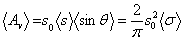 , where, , where,
 |
(39.10) |
The final value of the integration can be obtained as
 |
(39.11) |
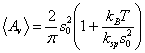
The average area per vertex is obtained as,
 |
(39.12) |
This estimation of from mean field approach corroborates very well with the MD simulation results.
|