Network of Springs
Let us assume that our system behaves as a harmonic spring and can therefore be represented as a spring network with appropriate symmetry. We can then define a microscopic quantity spring constant  for each spring which can finally yield the elastic modulii of the network. Let us consider the systems with six-fold symmetry as presented in figure below. Let the network be stretched slightly from its equilibrium position, so that the initial and final length of each springs are for each spring which can finally yield the elastic modulii of the network. Let us consider the systems with six-fold symmetry as presented in figure below. Let the network be stretched slightly from its equilibrium position, so that the initial and final length of each springs are  and and  respectively, then the potential energy of each spring can be written as respectively, then the potential energy of each spring can be written as
 |
(37.16) |
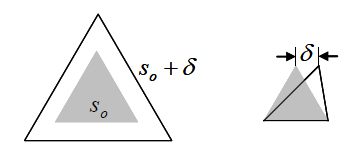
We can then estimate the potential energy density of the network. Consider the above triangular unit, the number of vertices is 1 while the number of springs is 3 which results in potential energy for each vertex as  . The network area per vertex is . The network area per vertex is  , so that the potential energy density per unit area of the network deformed to a small extent from the equilibrium configuration is defined as , so that the potential energy density per unit area of the network deformed to a small extent from the equilibrium configuration is defined as
 |
(37.17) |
Notice that the deformations are uniform along x and y directions respectively, so that we can write the normal components of the strain tensors in terms of and  : :
 |
(37.18) |
The displacement along y is independent of position along x, so that the shear components can be written as  . Use of these expressions for the strain tensor in the energy expression of equation 32.13 yield, . Use of these expressions for the strain tensor in the energy expression of equation 32.13 yield,
 |
(37.19) |
Comparing equation 37.19 and 37.17 we obtain the area compression modulus in terms of the spring constant of individual springs,
 |
(37.20) |
A similar analysis yields also the expressions for shear modulus. Suppose the network is sheared so that the vertex of a triangle at a particular layer is displaced to the right, say by a distance resulting in increase in its left arm by a distance  and shortening of the length of its right arm by a distance . Since the bottom arm remains undeformed the total potential energy is written as and shortening of the length of its right arm by a distance . Since the bottom arm remains undeformed the total potential energy is written as
 |
(37.21) |
The energy density per unit area is then obtained by dividing the above quantity by the area of the network:
 |
(37.22) |
Since we are considering pure shear, the normal components of the strain tensor are zero, i.e.  . The shear components can be estimated as . The shear components can be estimated as  . Using these expressions in equation 37.13, we obtain, . Using these expressions in equation 37.13, we obtain,
 |
(37.23) |
which when compared with equation 32.22, yields,
 |
(37.23) |
|