Six fold networks in 2D
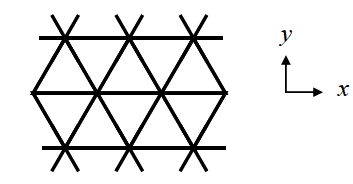
Figure 37.1 shows a two dimensional network which has six fold rotational symmetry through the vertices. We analyze this problem by changing the coordinate system from Cartesian coordinates x and y to complex coordinates  and and  . Then the free energy . Then the free energy  contains terms contains terms . Now a rotation about the origin of the x, y coordinate by an angle . Now a rotation about the origin of the x, y coordinate by an angle  changes the coordinates from changes the coordinates from  to to  and and  , in other word from , in other word from  to to   . Since six fold symmetry implies that the modulii remain unchanged because of rotation of the axis through . Since six fold symmetry implies that the modulii remain unchanged because of rotation of the axis through  i.e. i.e.  and and  . Only non-zero components of . Only non-zero components of  that remains unchanged by this transformation are those which contains equal number of times that remains unchanged by this transformation are those which contains equal number of times  and and  because because  . Only two components of satisfy this symmetry . Only two components of satisfy this symmetry  and and  . The change in free energy density can be then written as . The change in free energy density can be then written as
 |
(37.8) |
Which contains results from four combinations involving and two combinations involving . We can replace the strain components  by those in the Cartesian components in which we use components of tensor transform as products of the corresponding coordinates. Since, by those in the Cartesian components in which we use components of tensor transform as products of the corresponding coordinates. Since,
we can write,
From equation 37.8, the expression for energy density can be written as,

|
(37.11) |
We can relate the to modulii to more common forms of modulii, e.g. area compression modulus  and shear modulus and shear modulus  : :
 
|
(37.12) |
Hence, equation 37.11 changes to

|
(37.13) |
Equation 37.13 is very similar to that for isotropic deformation implying that in two dimension, both isotropic materials and six fold symmetry are represented by two different elastic modulii.
|
 ,
, and
and
 ,
,