| |
Other Factors affecting Kinetics of Coagulation
The effect of external forces (such as gravity, electric/ magnetic and other field forces) on the kinetics of coagulation has been a widely researched field. The particle in this case is “directed” rather than (purely) Brownian; this affects the collision frequency, and hence the rate of coagulation is affected. Other factors such as the building up of the concentration when particles hit a “boundary” (e.g. a wall or electrode), also need to be accounted for. Flow forces (such as applied shear) also have their effect on the rate coagulation/aggregation. The particle motion is now hydrodynamically controlled (rather than Brownian), i.e. orthokinetic rather than perikinetic coagulation. For laminar flows, the rate constant is now a function of the shear rate, and a stronger function of particle size.
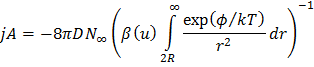
As mentioned earlier, the above derivation ignored hindered diffusion. Hydrodynamic correction factor, which was first introduced by Deryaguin (1966) takes into account that in the final stages of approach of two particles, they are slowed down because it is increasingly difficult for the remaining film to escape. If this hydrodynamic interaction is introduced, the following changes are made:

|