| |
Studying the stability of colloids is an important topic in the study of colloids. The manipulation of the state of dispersions, from stable to unstable, or the reverse is important for many applications. This manipulation can be carried out by altering the interactions between the particles, mainly through Electrostatic or Steric phenomena. In the current chapter we will focus on the former method which can be achieved through changes in the properties such as salt concentration, ion valence and pH. An important theory in this regard is the DLVO Theory (named after Derjaguin, Landau, Verwey and Overbeek).
DLVO Theory
DLVO Theory is the classical explanation of the stability of colloids in suspension. It looks at the balance between two opposing forces — Electrostatic repulsion and Van-der Waals attraction — to explain why some colloidal systems coagulate while others do not. For example, by adding Alum (AlCl3), suspended colloidal particles in dirty water could be made to settle down. Addition of the salt (Alum) causes the destabilization of the colloid. This theory has applications in predicting the stability of colloids in a number of Industrial processes such as liquid-liquid extraction, alkaline flooding operations, floatation of Hydrocarbons, stability of oil droplets in emulsions etc.
Consider two identical parallel flat plates (of type '1') in an electrolyte medium (of type '2') (a typical case of two colloid particles in a medium at a very close distance). These plates may have an excess surface charge due to an unequal distribution of lattice forming-ions, dissociation of surface groups or preferential adsorption of ions/surfactants.
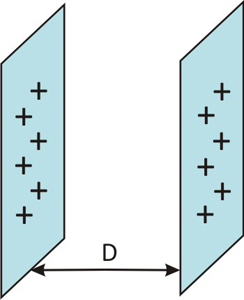
Fig. 10.1: Two identical flat plates in an electrolytic medium
For now, we consider that the surfaces have an excess charge and a surface energy of GTOTAL per unit area.
|