Comparisons of mechanical and thermal energy
Equations (30.18) and (30.20) show that the heat flux by conduction,  , is not present in the equation of mechanical energy and its contribution shows up only in the equation of thermal energy. Similarly, the heat addition by a heat so appears only in the equation of thermal energy. Also, as is shown letter the term
 is always positive and appears with a minus sign in the equation of mechanical energy while it appears
with a positive sign in the equation of thermal energy. Indicating the mechanical energy always degrades and converts into thermal energy. All these facts indicate that theses equations are consistence with the second law of thermodynamics which specifies that for an isolated system work can be converted into heat but not vice versa .
Temperature explicit form of the equation of thermal energy
Internal energy,  , is a state function which may be written in the terms of two intensive variables. If the intensive variables are temperature and volume, we may write
 and

where the symbol “^” represents the value of the property per unit mass or per unit mole.
From thermodynamics for fluids

For example, if fluid is an ideal gas then substituting the ideal gas law in the right hand side of Equation (31.2), we obtain

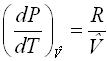

For real fluids, Equation (31.2) may be written in the form of the substantial derivative,i.e.,

Furthermore, the specific volume  is the inverse of the density ρ, or

Therefore,

Thus, Equation (31.4) reduces to

or

However, the equation of thermal energy is

From Equations (31.7) and (31.8), we obtain the temperature explicit form of equation of thermal energy as

Using the equation of continuity 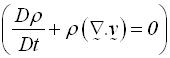 , in above equation, we finally obtain

which simplifies the equation (31.10) leads to


Equation (31.11) represents the equation of thermal energy in terms of temperatures for a real fluid. Expended form of Equation (31.11) in cartesian, cylindrical and spherical coordinate system is given in Appendix-5. Some limiting cases of Equation (31.11) are discussed below.
Case 1: heat conduction in solids
In solids, all velocities are zero and Equation (31.11) simplifies to

where, the heat flux  may be estimated by the Fourier’s law of heat conduction. If k is a constant then


Equation (31.13) is also known as the Fourier's second law of heat conduction.
Case 2 Heat transfer in fluids with constant ρ and k
For constant density, equation of continuity reduces to

In addition, the heat capacity at constant volume and constant pressures are the same. Thus,

For this case, the equation of thermal energy may be simplified to


Equation (31.18) represents the equation of thermal energy for constant density and heat conductivity. It may be noted that Equation (31.18) has a similar form as the equation of motion for constant density and viscosity (Navior Stoke equation), i.e.,

Both equations show the similarities between momentum and heat transport. The detail form of Equation (31.18) for different coordinate system is given in the Appendix -5
Viscous heat dissipation / viscous heating
The viscous heat dissipation term , in the equation of thermal energy represents the conversion of mechanical energy into thermal energy due to viscous dissipation. This term is always positive. For Newtonian fluids, may be calculated by using the Newton’s law viscosity. The details are not shown here but may be found elsewhere, i.e.,

or

where, Φv is a scalar quantity and the value of Φv for different coordinate system is given in the Appendix -6. As may be seen from this table that all terms present in the expression from Φv are positive. Thus, this viscous dissipation leads to increase the value of thermal energy and raises the temperature of fluid.