which
implies  and, if you consider the fact that exchanging two rows of a matrix in
succession will bring back the original matrix, then this result is obvious.
Coming back to the construction of the transformation matrix for the linear
system of equations under consideration, matrix and, if you consider the fact that exchanging two rows of a matrix in
succession will bring back the original matrix, then this result is obvious.
Coming back to the construction of the transformation matrix for the linear
system of equations under consideration, matrix  is now constructed as follows is now constructed as follows 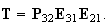
This approach of constructing the transformation matrix  demonstrated using a demonstrated using a  matrix matrix  can be easily generalized for a system of equations involving an can be easily generalized for a system of equations involving an  matrix matrix  .
For example, elementary matrix .
For example, elementary matrix  which reduces element which reduces element  in matrix in matrix  to zero, can be constructed by simply inserting to zero, can be constructed by simply inserting   at at  location in an location in an  identity matrix, i.e. identity matrix, i.e. 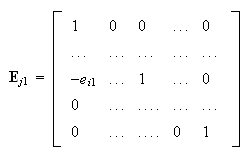 --------(21)while
the permutation matrix --------(21)while
the permutation matrix  which interchanges i'th and j'th rows, can be created by interchanging i'th
and j'th rows of the which interchanges i'th and j'th rows, can be created by interchanging i'th
and j'th rows of the  identity matrix. The transformation matrix identity matrix. The transformation matrix  for a general for a general  matrix matrix  can then be constructed by multiplying the elementary matrices, can then be constructed by multiplying the elementary matrices,  and the permutation matrices, and the permutation matrices,  in appropriate order such that in appropriate order such that 
It is important to note that the explanation presented in this subsection
provides insights into the internal working of the Gaussian elimination
process. While performing the Gaussian elimination on a particular matrix
through a computer program, neither matrices
( nor matrix nor matrix  is constructed explicitly. For example, reducing elements is constructed explicitly. For example, reducing elements  in the first column of matrix in the first column of matrix  to zero is achieved by performing the following set of computations to zero is achieved by performing the following set of computations  where where  Performing these elimination calculations, which are carried out row wise and
may require row exchanges, is equivalent to constructing matrices ( Performing these elimination calculations, which are carried out row wise and
may require row exchanges, is equivalent to constructing matrices ( and effectively matrix and effectively matrix  which is an invertible matrix. Once we have reduced which is an invertible matrix. Once we have reduced  to to  form, such that
u form, such that
u for all i, then it is easy to recover the solution for all i, then it is easy to recover the solution  using the back substitution method. Invertibility of matrix using the back substitution method. Invertibility of matrix  guarantees that the solution of the transformed problem is identical to that
of the original problem. guarantees that the solution of the transformed problem is identical to that
of the original problem. |
