| 8.2 Necessary Condition for Optimality |
| The necessary condition for optimality, which can be used to establish whether
a given point is a stationary (maximum or minimum) point, is given by the
following theorem. |
| |
| Theorem 43 |
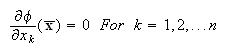
If  is continuous and differentiable and has an extreme (or stationary) point
(i.e. maximum or minimum ) point at is continuous and differentiable and has an extreme (or stationary) point
(i.e. maximum or minimum ) point at  then then |
| |
 |
---- (335) |
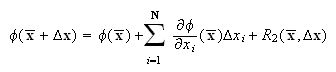
Proof: Suppose  is a minimum point and one of the partial derivatives, say the is a minimum point and one of the partial derivatives, say the  one, does not vanish at one, does not vanish at  then by Taylor's theorem then by Taylor's theorem |
| |
 |
---- (336) |
| |
 |
---- (337) |
Since  is
of order
( is
of order
( ) ) the terms of order the terms of order  will dominate over the higher order terms for sufficiently small will dominate over the higher order terms for sufficiently small  Thus, sign of Thus, sign of 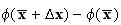 is decided by sign of is decided by sign of |
| |
 |
|
| Suppose, |
| |
 |
---- (338) |
then,
choosing  implies implies |
| |
 |
---- (339) |
and  can be further reduced by reducing can be further reduced by reducing  This
contradicts the assumption that This
contradicts the assumption that  is a minimum point. Similarly, if is a minimum point. Similarly, if |
| |
 |
---- (340) |
then,
choosing  implies implies |
| |
 |
---- (341) |
and  can be further reduced by increasing can be further reduced by increasing  This
contradicts the assumption that This
contradicts the assumption that  is a minimum point. Thus, is a minimum point. Thus,  will be a minimum of will be a minimum of  only
if only
if |
| |
 |
---- (342) |
Similar
arguments can be made if  is a maximum of is a maximum of  |
