Definition
42 (Angle)
The angle  between any two vectors in an inner product space is defined by between any two vectors in an inner product space is defined by 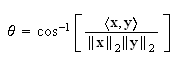 ----------- (54) ----------- (54)
Definition
43 (Orthogonal Vectors):
In a inner product space  two vector   are
said to be orthogonal if  We
symbolize this by  A
vector  is said to be orthogonal to a set  (written
as  )
if  for each  
Just as orthogonality has many consequences in three dimensional geometry, it
has many implications in any inner-product / Hilbert space Luen. The Pythagoras theorem, which is probably the
most important result the plane geometry, is true in any inner product space.
Lemma
44
If  in an inner product space then  .
Proof: 
Definition
45 (Orthogonal Set):
A set of vectors  in an inner product space  is said to be an orthogonal set if  for each   and  The set is said to be orthonormal if, in addition each vector in the set has
norm equal to unity.
Note that an orthogonal set of nonzero vectors is linearly independent set. We
often prefer to work with an orthonormal basis as any vector can be uniquely
represented in terms of components along the orthonormal directions. Common
examples of such orthonormal basis are (a) unit vectors along coordinate
directions in  (b) function (b) function  and and  in in ![$L_{2}[0,2\pi].$](../../../images/module2/graphics/Module_2_Vector_Spaces_Fundamentals__504.gif) |
