Axioms 2 and 3 imply that the inner product is linear in the first entry. The
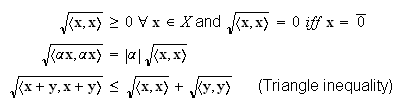
quantity  is a candidate function for defining norm on the inner product
space is a candidate function for defining norm on the inner product
space Axioms 1 and 3 imply that Axioms 1 and 3 imply that   and axiom 4 implies that and axiom 4 implies that  for for  If we show that If we show that  satisfies
triangle inequality, then satisfies
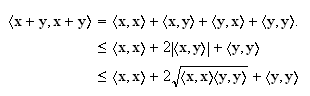
triangle inequality, then  defines a norm on space defines a norm on space  . We first prove Cauchy-Schwarz inequality, which is generalization of
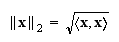
equation (cos), and proceed to show that . We first prove Cauchy-Schwarz inequality, which is generalization of
equation (cos), and proceed to show that  defines the well known 2-norm on defines the well known 2-norm on  i.e. i.e. 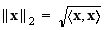 . .
Lemma
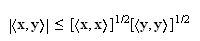
41 (Cauchey- Schwarz Inequality):
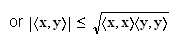
Let  denote an inner product space. For all  ,the following inequality holds |