Two dimensional plane passing through origin of .
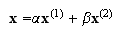
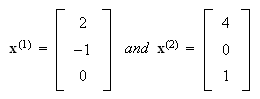
For example, consider the set of collection of all vectors where are arbitrary scalars and i.e. This
set defines a plane passing through origin in Note that a plane which does not pass through the origin is not a sub-space.
The origin must be included in the set for it to qualify as a sub-space.
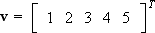
Let where and let us define span of as where represents a scalar. Here, is one dimensional vector space and subspace of
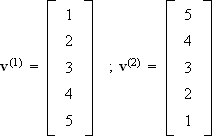
Let where ----(5) Here span of (i.e. )
is two dimensional subspace of .
Consider set of order polynomials on interval .
A possible basis for this space is ----(6)
Any vector from this space can be expressed as ---(7)
Note that in this case is dimensional subspace of .
Consider set of continuous functions over interval, i.e. A well known basis for this space is
---(8)
---(9)
It can be shown that is an infinite dimensional vector space.
6. The set of all symmetric real valued matrices is a subspace of the set of all real valued matrices. This follows from the fact that matrix is a real values symmetric matrix for arbitrary scalars when and








![$\left[ S\right] $](../../../images/module2/graphics/Module_2_Vector_Spaces_Fundamentals__149.gif)


 ----(5)
![$[S]$](../../../images/module2/graphics/Module_2_Vector_Spaces_Fundamentals__154.gif)

 order polynomials on interval
 ![$[0,1]$](../../../images/module2/graphics/Module_2_Vector_Spaces_Fundamentals__157.gif) .
A possible basis for this space is
.
A possible basis for this space is  ----(6)
 from this space can be expressed as
  ---(7)
 ![$[S]$](../../../images/module2/graphics/Module_2_Vector_Spaces_Fundamentals__161.gif) in this case is
in this case is  dimensional subspace of
 ![$C[a,b]$](../../../images/module2/graphics/Module_2_Vector_Spaces_Fundamentals__163.gif) .
. ![$C[-\pi,\pi].$](../../../images/module2/graphics/Module_2_Vector_Spaces_Fundamentals__164.gif) A well known basis for this space is
A well known basis for this space is
![$C[-\pi,\pi]$](../../../images/module2/graphics/Module_2_Vector_Spaces_Fundamentals__166.gif)


