The biological interactions involve mostly non covalent interactions between the reactive groups of molecule targeted for purification and ligand with a dissociation constant Kd.
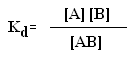
Where, A is assumed as molecule targeted and B as ligand and AB is the complex formed between them. Kd varies between 10 -3 to 10 -7 M for affinity binding.
The principle of affinity chromatography is that the stationary phase consists of a support medium (e.g. cellulose beads) on which the substrate (or sometimes a coenzyme) has been bound covalently, in such a way that the reactive groups that are essential for enzyme binding are exposed. As the crude mixture of proteins is passed through the chromatography column, proteins with binding site for the immobilized substrate will bind to the stationary phase, while all other proteins will be eluted in the void volume of the column.
Once the other proteins have all been eluted, the bound enzyme(s) can be eluted in various ways.
We will discuss elution methods in during coming lectures.
|

