Step 5: Amplification and purification of recombinant plasmid DNA
The final step in DNA cloning is the isolation of the cloned recombinant DNA. A positive colony containing recombinant plasmid is identified and it is aseptically transferred to liquid medium and cell are allowed to grow exponentially overnight. A fully grown culture contains trillions of identical cells, which is harvested for the isolation of the plasmid DNA. The plasmid DNA is purified from harvested bacterial cell lysates. The purified plasmid DNA is dissolved in an appropriate buffer solution and can be used for further confirmation of the clone by restriction digestion and sequencing the plasmid DNA.
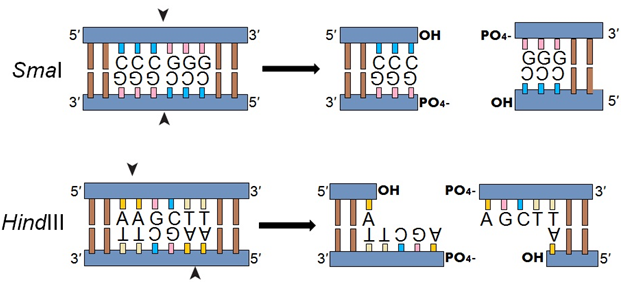
Figure 1:Cleavage patterns of Hin d III and Sma I restriction endonucleases. The recognition sites and cleavage patterns of Hin dIII and Sma I are shown. Restriction endonucleases catalyze the hydrolysis of phosphodiester bonds in palindromic DNA sequences to produce double-strand breaks, resulting in the formation of 5'-PO 4 - and 3'-OH termini with "sticky" ends (Hin dIII) or "blunt" ends (Sma I).
|

