Overview of Deoxyribonucleic Acid (DNA) and Ribonucleic Acid (RNA) Structure.
Download this lecture
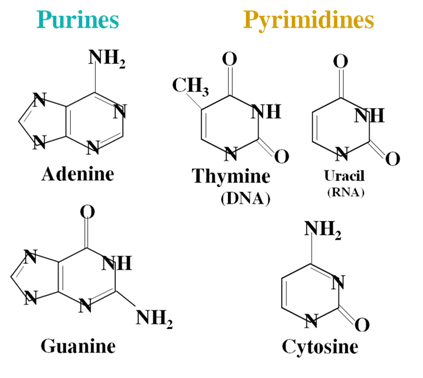
Nucleic acids play an important role in the storage and expression of genetic information. They are divided into two major classes: deoxyribonucleic acid (DNA) functions solely in information storage, while ribonucleic acids (RNAs) are involved in most steps of gene expression and protein biosynthesis. All nucleic acids are made up from nucleotide components , which consist of a nitrogenous base , a sugar and a phosphate residue. A sugar and a nitrogenous base without the phosphate group is called as a nucleoside. The nitrogenous bases are classified into two types:-
......• .Fused 5 & 6 membered rings (heterocyclic) called as Purines eg: Adenine (A) ..........and Guanine (G).
- ..Six membered rings called as the Pyrimidines eg: Thymine (T), Cytosine (C) ..and Uracil (U).
...........Free purines and pyrimidines are weakly basic and are thus called bases.
|
