Other Methods of Directed Evolution: The other methods of directed evolution are error-prone PCR and DNA shuffling. The gene of protein is mutated using these two methods and MUTANT WITH DESIRED PROPERTIES IS SELECTED AND AMPLIFIED using appropriate methods as we have seen in the case of phage display technology.
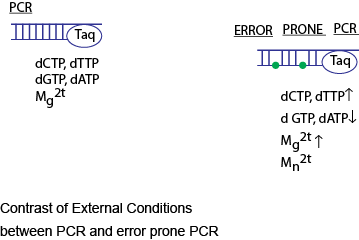
Error Prone PCR: We shall discuss about polymerase chain reaction (PCR) in detailed during module 7 of the course. Error prone PCR is a variant of PCR. Error prone PCR is a technique used to generate randomized genomic libraries. It allows the initiation of DNA amplification, starting with tiny amounts of parent molecule, and produces considerable amounts of the mutated gene. The working principle of this technique is based on the ability of Taq polymerase to anneal incompatible base-pairs to each other, during amplification, under imperfect PCR conditions. Under these conditions, the polymerase makes mistakes in the base paring during DNA synthesis which inculcates errors in the newly synthesized complementary DNA strand. The frequency and number of errors introduced into the sequence can be regulated by carefully controlling the buffer composition. For proper functioning of this technique, it is important to use a Taq DNA polymerase which lacks proof-reading ability, because use of a proof-reading DNA polymerase in an error prone PCR reaction will result in the automatic correction of the mismatched nucleotides, therefore any mutations that were introduced during the reaction will be lost. This method has proven useful not only for generation of randomized libraries of nucleotide sequences, but also for the introduction of mutations during the expression and screening process in the mutagenesis step.
DNA shuffling: DNA shuffling is also known as sexual PCR. Before beginning with DNA shuffling, a pool of closely related molecules, with different point mutations, is prepared either through error-prone PCR or other mutation techniques such as oligonucleotide-directed mutagenesis.
Various steps involved in DNA shuffling are as follows:
- Step 1: Breakage of molecules into random fragments using DNase I which can randomly create nicks along each strand of a DNA molecule.
- Step 2: Sampling of fragments of lengths within a certain range.
- Step 3: Further these sampled fragments go through PCR without added primers . There are three steps in the PCR process without primers.
Step 3A: Denaturing of double-stranded fragments by increasing the temperature, so that double stranded DNA are separated completely into single- stranded ones.
Step 3B: Annealing by lowering the temperature, so that single-stranded fragments anneal to other fragments overlapping by a certain number of bases that are complementary at the overlapping region. Once annealing step is over, homologous templates prime each other to form 5 ' and 3 ' overhangs.
Step 3C: Polymerase extension by increasing the temperature optimum for DNA polymerase to extend the 5' overhangs using the other annealed strand as template. The 3' overhangs are not changed as DNA polymerase can only extend from a 5' end.
The three steps of denaturation, annealing and polymerase extension are repeated for multiple cycles. Diagrammatic representation of DNA shuffling is shown in Figure 5.
|

