Introduction to Mass Spectrometry-I
Download this lecture
Mass spectrometry (MS) is an analytical technique that measures the mass/charge ratio of charged particles in vacuum. Mass spectrometry can determine masse/charge ratio with high accuracy. Molecules in a test sample are converted to gaseous ions that are subsequently separated according to mass/charge ratio. Several types of experiments can be performed with mass spectrometry. We shall see a few examples in coming lectures.
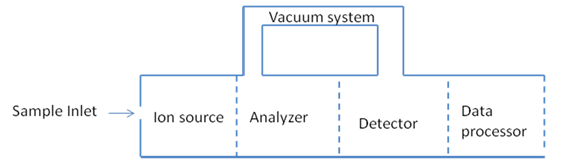
A typical mass spectrometry instrument has three components
as shown in Fig. 1.
- Ion source
- Analyzer
- Detector: The detector records the current produced when an ion passes by or hits a surface. Several types
of detector are used like electron multiplier, Faraday cups and ion to photon detectors.
Figure 1: Basic components of mass spectrometry
All mass spectrometry operate under vacuum (10-6 torr pressure). Without high vacuum, the ions produced in the source will not reach the detector. At atmospheric pressure, the mean free path of a typical ion is around 52 nm; at 1mtorr, it is 40 mm; and at 10-6 torr, it is 40 m. Sample inlet may be coupled to a liquid chromatography system (call LC-MS), gas chromatography system (GC-MS) or capillary electrophoresis system.
|