Module 5 : Label-free proteomic techniques
Lecture 32 : Nanotechnologies in Proteomics
 

(d) Gold nanoparticles and nanocages

Gold nanoparticles (AuNPs) possess unique optical, electronic and catalytic properties and can efficiently immobilize biomolecules, which makes them suitable for biosensing (Fig 4) (Boisselier and Astruc, 2009). They are also well suited for HT applications in array design.

Fig 4. Working principle of gold nanoparticles (AuNPs). AuNPs are compatible for selective and ultrasensitive detection  of  protein  biomarkers due to their unique  optical,  electronic  and  catalytic  properties  and  signal  enhancement  capability.  AuNPs can amplify signal effectively if introduced in electronic biosensing process.

Due to the following properties AuNPs can act as an efficient signal amplifier:

  • Much smaller than the wavelength of light
  • Strong scattering and absorption peaks in the near-infrared region
  • Narrow spectral bandwidth
  • Excellent prospective for signal amplification and compatibility for multiplex HT analysis
  • Potential optical probes for reflectance-based optical imaging
  • Binding of biomolecules leads alterations in spectra of scattered light
  • Ability to conjugate with antibodies or peptides and homogeny in target binding

Content on this page requires a newer version of Adobe Flash Player.

Get Adobe Flash player

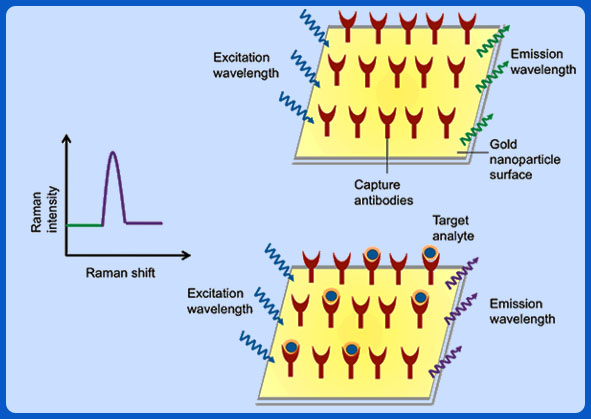
Illustration: Gold nanoparticles

The gold nanoparticle surface is functionalized suitably by antibodies, which binds to the analyte of interest. Any target binding is depicted by a change in the emission spectra. The analyte of interest is detected by the antibody-functionalized gold nanoparticle surface. Changes in the emission spectra get recorded indicating binding. Gold nanoparticles thus form a very useful and sensitive label-free detection system that can detect particles down to pM levels.