Module 5 : Label-free proteomic techniques
Lecture 32 : Nanotechnologies in Proteomics
 

(c) Quantum dots

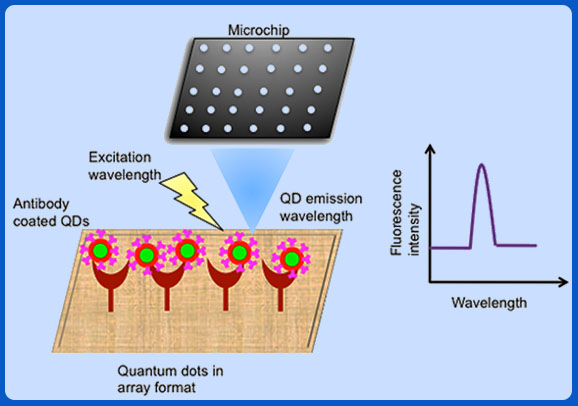
Quantum dots (QDs) are inorganic flourophores, whose excitons are confined in all three spatial dimensions. QDs are semiconductor in nature and attractive labeling mediator for the sensitive detection of target proteins in HT format. Detection of target proteins are performed by monitoring the emission spectra of bound QDs (Fig 3) (Azzazy et al., 2007; Resch-Genger et al., 2008).

Fig 3. Working principle of quantum dots (QDs). Biomolecules can be labeled using quantum dots (QDs).  Monitoring of emission spectra of bound QDs allows real-time detection of the targets analytes. Fluorescence Resonance Energy Transfer (FRET) between fluorescence acceptors and a QD donor generates fluorescence emission.

Due to the following properties QDs can act as an effective signal amplifier:

  • Wide range of excitation and stable optical properties
  • Size-tunable narrow and symmetric emission spectra
  • High photostability and fluorescence quantum yields, fluorescence lifetimes: 10-100 ns
  • Surface chemistry controls stability and bigger surface area
  • Suitable for labeling biomolecules and single molecule analysis
  • Semiconducting nature and resistant to chemical and thermal effects

Content on this page requires a newer version of Adobe Flash Player.

Get Adobe Flash player

Illustration: Quantum dots

Changes in emission wavelength upon binding to the antibody-conjugated QDs are recorded by the microchip and used for detection of various biomoleules. QDs are capable of detecting molecules down to fM levels and provide significant advantages over conventionally used organic fluorophores.