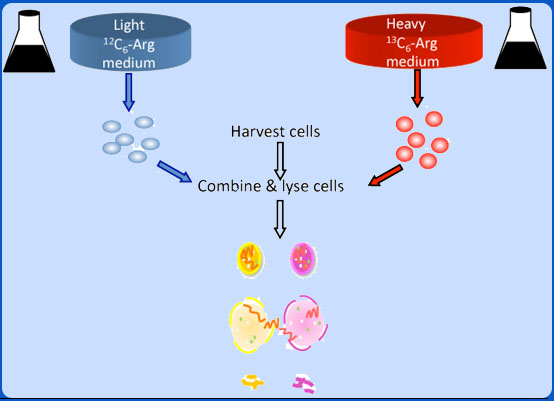
SILAC is a metabolic strategy of incorporating tags into proteins by usage of isotopically labeled amino acids in the cell culture media. It depends on the cellular protein synthesis machinery for the uptake of amino acids from the media and incorporating them into the proteome. Ideally, in SILAC a wide range of isotopes can be used. Mostly, 13C is used as a stable isotope for labeling the amino acids. The usage of carbon as a stable isotopic tag was limited earlier due to the presence of carbon in other bio-molecules. But in SILAC due to the ability to specifically label amino acids, it becomes easier to use either nitrogen or carbon or oxygen as a stable isotopic tag.
As the cell grows in labeled lysine or arginine containing media, slowly the cellular machinery starts incorporating the tags into the proteins, and with natural turnover of cell and the proteins, ultimately after a few generations, the entire proteome gets labeled. As a control, cells are also grown in light media for comparison. SILAC provides a basis for absolute quantification of proteins because the tags are naturally incorporated during protein synthesis and hence there is no chance of fabrication as is the case for iCAT or iTRAQ, where the labels are added externally after protein digestion. The difference in the relative abundance of peptides between heavy and light samples is a measure of the degree of differential expression of that particular protein on external stimuli (Fig 2). |