Biomarkers are bio-molecules, usually proteins, which serve as identifying agents for many diseases. Hence, biomarker discovery is an extremely hot area for research, especially in cancer diagnosis. However, biomarker discovery is extremely challenging, given the fact that they are extremely low in amount, during the early stage of the disease, which is why sophisticated techniques are required for their detection. Also, because of their low molecular weight, they are often masked by high molecular weight proteins. The introduction of sophisticated and sensitive labeling strategies like iTRAQ and SILAC has revolutionized the usage of MS in biomarker discovery. Using iTRAQ reagent, many important biomarkers have been brought to light.
An example is orosomucoid 2 (ORM2), a potential biomarker for colorectal cancer, which is up-regulated by approximately 4.1 folds during the disease. Zhang et al, reported the increase in the level of ORM2, in colorectal cancer. ORM2 is 24 kDa inflammatory protein present in the plasma in very low amount during the early stages of colorectal cancer. As the disease progresses, the level of ORM2 increases and hence, this protein can be used as a potential biomarker for colorectal cancer. ORM2 because of its low molecular mass is often masked by other serum proteins, and hence, Zhang et al, used depletion approach where the plasma was depleted of high abundant protein and then using sophisticated micro Q-TOF coupled with iTRAQ, the levels of ORM2 could be detected with a confidence limit of greater than 95%. The ability to quantitate thus provides an idea as to the identity of the potential biomarkers for that particular disease.
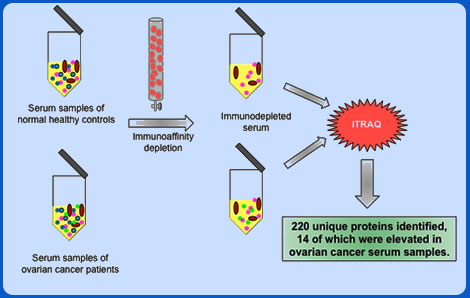
A parallel study conducted by Chen et al on urinary bladder cancer led to the discovery of apolipoprotein A I/II, heparin cofactor II precursor as potential biomarkers for the disease. Using iTRAQ based quantitative proteomic approach on urine samples obtained from healthy and diseased individuals, these biomarkers were discovered, which were up-regulated by more than 2 folds. Further validation was performed using western blotting and ELISA based assays. Another study by Boylan et al. investigated biomarkers in ovarian cancer (Fig 3), which is illustrated in animation. |