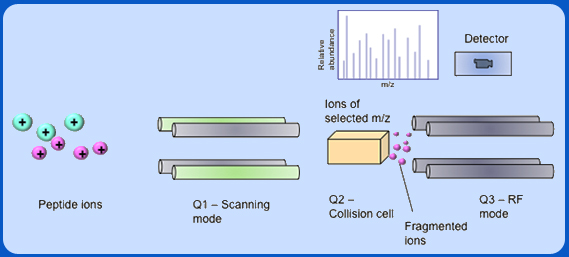
The linear quadrapole consists of 4 sets of parallel metallic rods maintained at different potential difference to facilitate sequential elution of ions towards the detector. However, the resolution of quadrapole was very poor as more than two closely related peptides would reach the detector simultaneously. To address the problem, triple quadrapole was designed wherein; a collision cell separated two quadrapoles. The TQ is operated in two modes: radio frequency mode and scanning mode. Radio frequency mode refers to the mode whereby the potential difference is set so that all ions are allowed to move into the next chamber, whereas in the scanning mode only selective ions are allowed to move. In TQ, the first quadrapole is maintained at scanning mode, hence allows selective ions to move into the collision cell where the ion is fragmented into daughter ions. The third quadrapole is maintained at radio frequency mode, allowing all the daughter ions to reach the detector and thus get an idea about the fate of the parent ion. This is particularly useful in a phenomenon known as MRM, multiple reactions monitoring, where the fate of the parent ion is studied. This finds applications in both pharmaceuticals and proteomics, where the metabolism of a particular drug or a protein in question may be studied. |